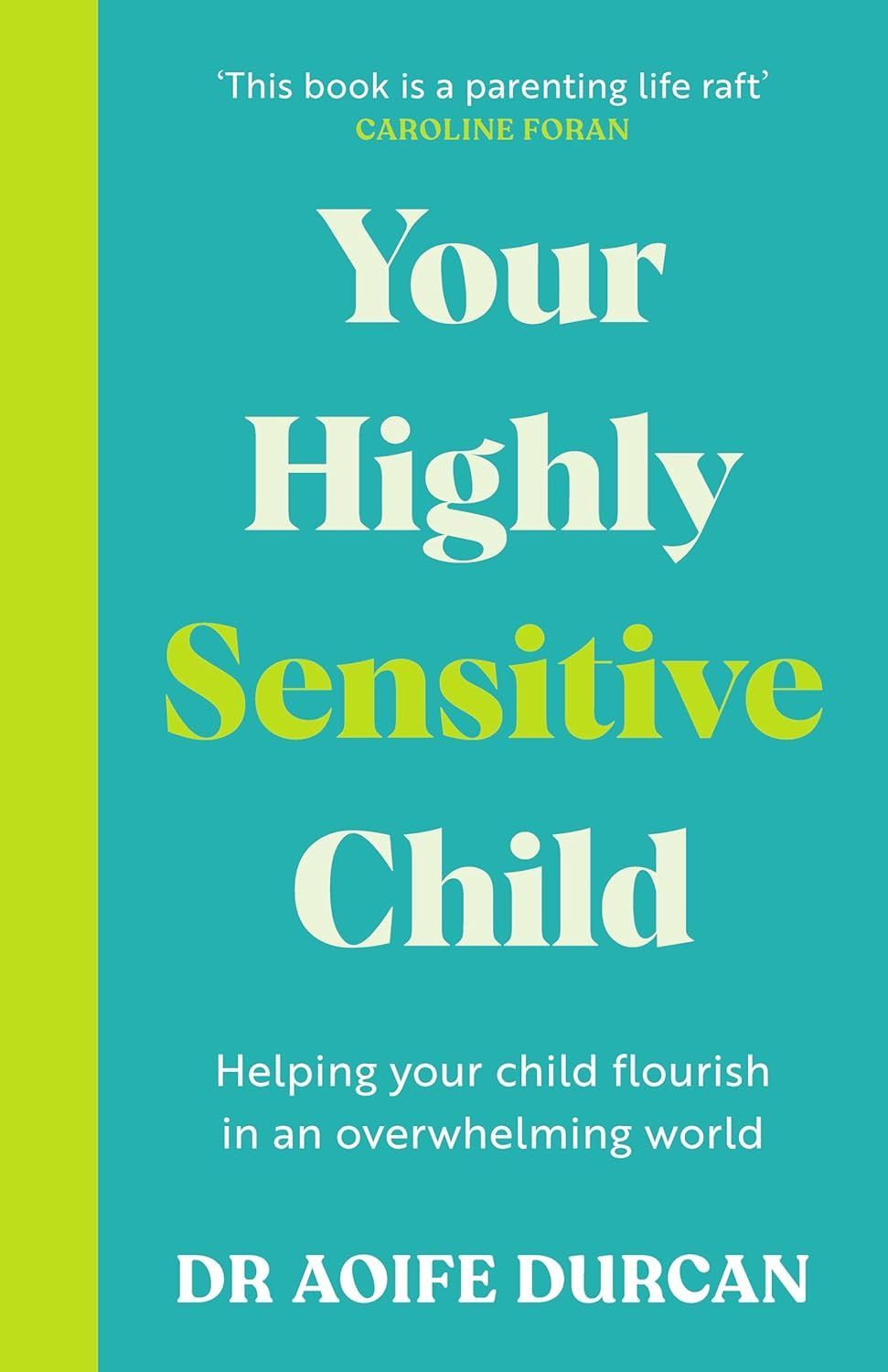
YOUR HIGHLY SENSITIVE CHILD BY DR AOIFE DURCAN BOOK REVIEW
“My biggest piece of parenting advice is to try your best to let your child feel really seen by you. Even when their behaviour is confusing and you don’t understand, let them know you are trying to and that they mean the world to you”
The goal of the book is to help parents understand their highly sensitive child as well as provide us with some tools to help them flourish. She talks about wanting children to “feel understood, validated and loved for who they are deep down…and empowered in whatever way their wonderful selves are wired”. This fits so beautifully with my main approach in therapy but oh so relevant to parenting and relationships in general – the PACE model (Playfulness, Acceptance, Curiosity and Empathy).
A clear and compassionate read
“It is perfectly normal for some children to seek more connection and soothing. They may want more hugs, more closeness and more holding, and that is not something we need to fear or pathologise”.
I could tell straight away what a good clinician Aoife must be from the way she writes – with such connection, empathy and understanding of both parents and children’s experiences. As a parent who has (what I’d now call a highly sensitive child) it really connected with me on a personal level. Her explanation of psychological theories is amazingly clear – something which is sometimes lacking in books written by professionals. This is particularly impressive as she beautifully validates emotive topics (such as sleep and our own history).
Summary
This book so beautifully focuses on children and adults and, I suspect, many of us with highly sensitive children would fit the profile ourselves. It will be a great help to many – providing ways to support both our children but to help us flourish as well.
I knew a lot of the theory and ideas in the book (as a psychologist of 20 years I was relieved about that!) but for parents there is a wealth of new knowledge and for me it was a useful reminder.
Here is a breakdown chapter by chapter:
Chapter 1: Understanding your sensitive child
Aoife talks about what sensitive means (something I would love to explore further with her in terms of temperament, neurodivergence and early experiences – all of which she describes but something I want to know more about). Aoife describes “the difference between high sensitivity and these other forms of neurodivergence is that they encompass features of a distinct brain style beyond sensitivity alone”, acknowledging that there can be concern that identifying a trait of high sensitivity may lead to a missed diagnosis of other forms of neurodivergence and that it has been somewhat controversial a term in the neurodivergent community.
She talks about the importance of co-regulation (something I bang on about a lot!) and describes goodness of fit (how well our child’s environment fits their unique needs) which was a good reminder to me that my children need different things to thrive.
Throughout the book Aoife weaves in case studies, and I love the way she shares a deep understanding with other parents who have often experienced “huge amounts of self-blame and shame” when looking after their highly sensitive child.
I love her deeper dive into sensitivity, where she outlines Dr Elaine Aron’s main characteristics of sensitivity with the acronym DOES (depth of processing, overstimulation, emotional reactivity and sensing the subtleties). Sometimes I thought I was reading specifically about my son (and sometimes myself!).
Chapter 2: Your child’s window of tolerance
“If we keep coming back to the premise that our children are acting mainly from their emotional brain and an underdeveloped ability for impulse control, it helps us understand a little more. The more we pause ourselves and imagine how it feels to be in their shoes, their behaviour often makes sense”.
She describes highly sensitive children as orchids, with very big hearts and highlights that there is an increased activation in areas of the brain which are associated with awareness, integration of sensory information, empathy and action planning (I’m going to ask more about this research when we have our live). It made so much sense that children with more finely tuned nervous systems, who detect danger more easily than others are more likely to be on edge. A much better way of understanding children who are struggling than thinking their behaviour is bad – they are just responding to what signals their body is sending to them.
After helping us understand what may be going on for highly sensitive children, Aoife talks about the window of tolerance, sleep, transitions and the three R’s (regulate, relate and reason). I scribbled a lot on this chapter as it resonated so much with me and served some lovely reminders to me as a parent and psychologist, particularly when Aoife highlighted how children can become ashamed of their actions (that they have little control of) and how anger can turn to tears when we respond with empathy and kindness.
Chapter 3: Our own life history
I love this chapter! Many parenting books forget that we are key to our child’s emotional wellbeing and leave us out! Aoife talks about our own critical voice, comparing ourselves with others, vulnerability and our emotional and physical health. She outlined the RAIN of self-compassion model (Recognise, Allow, Investigate and Nurture) which was new (and helpful) to me and, I suspect, draws on her experience of working with adults I suspect). It is written warmly and compassionately and is much more comprehensive than you normally see. There was not one inch of parent shaming which can sometimes slip into books (inadvertently).
Chapter 4: How we learn to protect ourselves
We often focus on what we as adults are getting wrong but Aoife clearly outlines how we as well as our children learn to cope to protect ourselves (which fits really nicely with attachment theory which I draw on heavily in my work). She describes “protectors” such as perfectionism, people-pleasing, self-soothing (I’d always thought of this as a good thing) and control. Helpfully, this chapter includes practical grounding and soothing techniques.
Chapter 5: Temperament, being ‘shy’ and understanding anxiety
“separating from \us will often cause our more sensitive souls stress. The stress makes so much sense (we are their safe place)l…In an ideal world, we really want the childcare setting to be another nurturing, warm and attuned relationship our child has in their life”
Aoife focuses on some of the things that highly sensitive children may find harder in this chapter – whilst often reframing them with a positive spin e.g. the ‘pause to check’ system). She talks about separation anxiety, temperament, childcare, big emotions after school and helping children move into their “optimal zone of tolerance” to help them learn new skills without feeling overwhelmed.
I like the way worries are framed as a powerful coping protector that manifests when we feel scared, sad or like we are not good enough…it helps to go straight to the underlying need our child may be communicating rather than get caught up in the cognitive content of the worries – to feel safe, loved, validated, understood and accepted,
True confidence comes from knowing deep down at your core that \you are a worthy person, and you are lovable as you are. We can be confident and quiet, and being ‘shy’ is not a negative thing
According to Aoife, 70% of \highly sensitive people identify with the trait of introversion (not mine). I love the term “introverted extravert” (a new one to me) whereby the extrovert in someone gets a lot from the external world but their nervous system is easily overstimulated (remember DOES from chapter 1?). there are some \helpful tips on supporting children who are described as “shy” – both for them and for others trying to get them out of their shell (more about the others’ needs than the child’s?) Certainly something I've been guilty of).
Chapter 6: The empath
“Learning to be with painful feelings, without trying to fix them, is so connecting for our relationships -especially for empaths. We need to understand that we can't talk them out of their feelings. The only way their emotions move is by giving them the space to be felt. It is only then we can begin thinking of ideas that may help”
This chapter helps (worn out) parents understand their child's big feelings. Aoife talks about anger, getting suck in emotions and how important it is not to dismiss them, which can lead to a deep sense of confusion. She describes how her own deep-feeling nervous system has experienced an emotion so strongly that it takes time to lift and, when it hasn’t been seen and understood, it takes longer to process.
This was so helpful for understanding my son, who picks up on emotions so easily (he even knows when I'm getting my period before I do!).
Chapter 7: Criticism and being ‘good’
Criticism can feel so painful for highly sensitive children – even when it's meant as constructive feedback. Aoife talks about how important it is to validate their experiences, even if their reaction seems a bit extreme to us! She describes ways to help them find their voice and move forward when feeling criticised.
This chapter also talks about how highly sensitive children can get really upset about doing the right thing or feeling like they have disappointed you. I love her point that we may expect more from them as they are so emotionally in tune and articulate – but this can miss the point that they are driven mainly from their emotional brain with limited impulse control. She talks about boundaries and children who apologise too much (or too little!) as well as how to support them when they feel misunderstood.
Chapter 8: Navigating painful emotions
“Sadness can be a familiar emotion for a sensitive soul. Feeling the world deeply and noticing how painful life can be sometimes, and experiencing grief, loss, feeling excluded, rejection and being misunderstood can evoke feelings of sadness and loneliness.”
Its so hard when our children are experiencing deeply painful emotions and we feel a bit stuck as to what to do., this chapter talks about trust, grief, sibling relationships and feeling different, outlining ways you can support your child to make sense of their experiences and emotions – through their connected relationship with you.
Chapter 9: Understanding our strong-willed children
Aoife goes back to basics in this chapter, delightfully explaining why some of the traditional behavioural methods of parenting are a particularly bad fit with our more strong-willed children (as I have learnt through experience over the years!). she talks about the need to give children a sense of agency, control and flexibility and provides a lovely reactivity guide (screening list) to help us understand what our children may be communicating with us. Again, Aoife highlights the importance of co-regulation as well as understanding and managing our response. She also describes how repair is key – something I talk about a lot. Time in is outlined (as an alternative to time out…something that I’ve talked about before in previous posts).
Chapter 10: Sensory sensitivities
As psychologists (particularly those of us that trained 20 years ago!) we weren’t well versed in the importance of sensory profiles – but it is now so clear that our mind and body work together and that we need to be aware of both if we are going to support children’s emotional and behavioural development. This chapter outlines the different senses and how our bodies read our environment, which is hugely different for each and every one of us. She talks about both parents' and children’s sensory needs and how we can empower sensory-sensitive children.
Chapter 11: My wish for every parent
The last chapter of Aoife’s book is beautifully written, outlining what she wishes for parents. She talks about comparison traps, trusting yourself, asking for help, avoiding self-blame and bringing more fun and play into your (and your children’s) lives. I am always a bit biased to chapters about parents as we are so important if we are going to be the best parents we can be…and Aoife highlights this wonderfully here.